

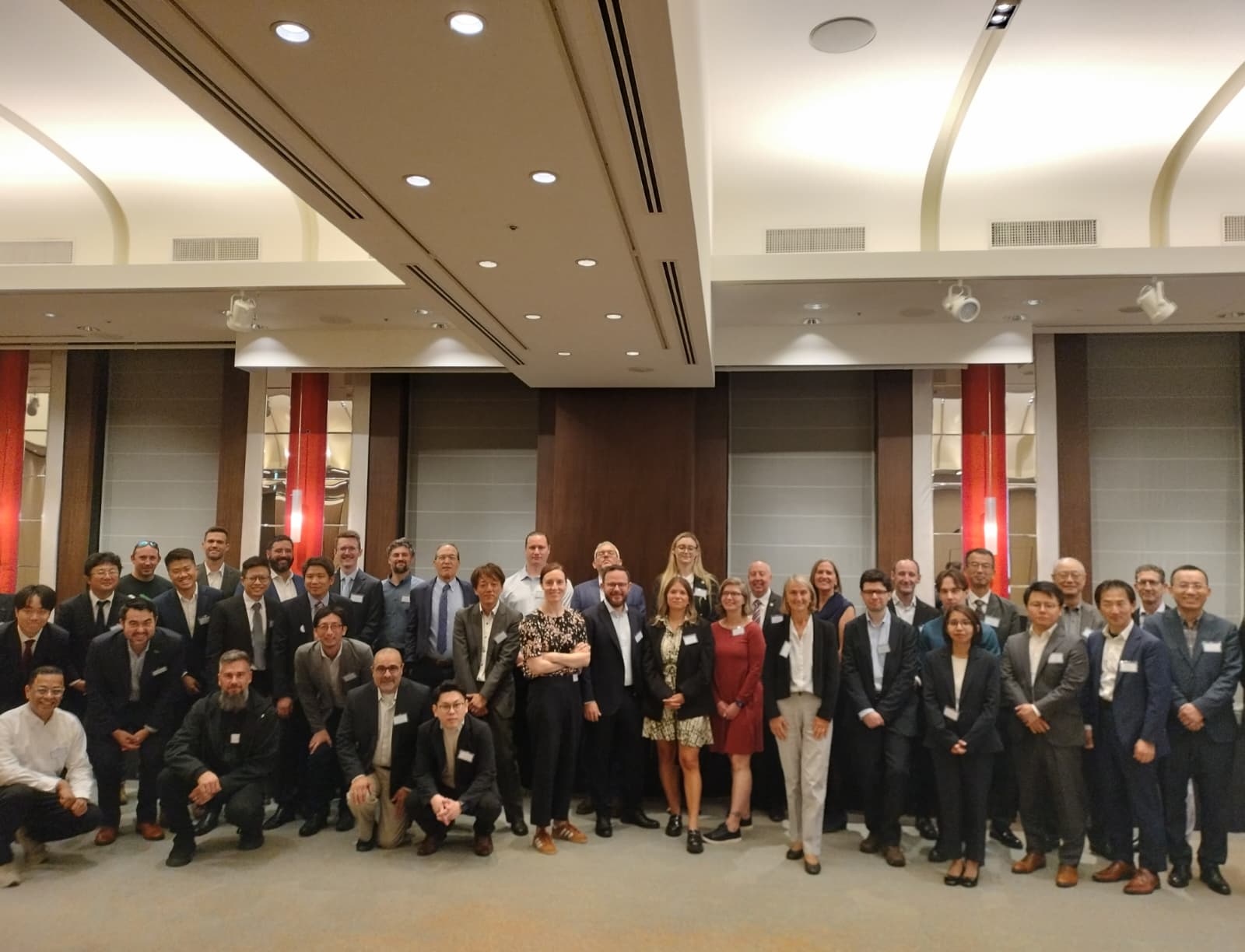
On 5 October 2026, the InterUSS Platform brought its community to Tokyo for the Advisory Council and an Open Industry Workshop, welcoming more than 40 participants to connect, exchange perspectives and explore how open-source solutions can support the development of interoperable UTM ecosystems.
Held in Japan for the first time, the workshop created an opportunity to introduce the InterUSS Platform and its work to a broader industry audience, while bringing a local perspective into the global conversation around UTM implementation.

From open-source tools to real-world implementation
The workshop provided participants with an overview of the tools developed by the InterUSS community and their implementations.
Two core products were presented: the InterUSS Automated Test Suite and the Discovery and Synchronization Service (DSS).
The Automated Test Suite enables validation against standards and regulations, supporting both service providers and competent authorities. The DSS, meanwhile, serves a different role: within a defined location, it allows a USS to identify the other USSs with which it needs to exchange information and verify the relevance of that exchanged data. These tools already support UTM operations in the United States, Switzerland, Australia and the United Kingdom.
The FAA also highlighted the scale reached by the current US implementation, with 17 service providers and operators, two live services, Strategic Coordination and Network Remote ID, and more than 1.85 million flights managed in 2026.
This provided a practical backdrop for the wider workshop discussion: moving from the development of common tools towards implementation models capable of supporting operational UTM environments.
Connecting the global community with Japan
A key part of bringing the workshop to Tokyo was connecting the international InterUSS community with perspectives from Japan.
Shinji Nakadai, CEO of Intent Exchange, contributed to the program with a dedicated presentation, bringing a Japanese perspective into the discussion on UTM implementation.
The session helped set the stage for the workshop’s broader discussion on how InterUSS technologies and approaches can be considered in different implementation environments, while connecting stakeholders in Japan with a community already contributing to UTM and U-space deployments internationally.
Exploring future InterUSS implementation models
The program then moved into an open discussion on future InterUSS implementation models, giving participants an opportunity to exchange perspectives on how the platform can support diverse operational and market contexts.
Rather than focusing on a single implementation model, the session was designed as an open conversation around the future use of InterUSS. Therefore, the workshop connected two sides of the InterUSS mission: developing open-source solutions and creating a community to scale the UTM implementation.
Continuing the InterUSS conversation beyond Tokyo
With more than 40 participants, the Tokyo workshop marked an important opportunity to broaden engagement with the InterUSS community in Japan and strengthen connections with stakeholders working on the next stages of UTM implementation.
As UTM and U-space implementation continues to advance in different parts of the world, bringing these perspectives together remains central to InterUSS: building open technology, connecting communities and providing tools that can support interoperable approaches across markets.

An open-source approach to UTM
The InterUSS Platform, an initiative of the Linux Foundation, works to enhance communication and collaboration within the drone industry through open-source implementations and industry partnerships. Its work is built on the idea that common, publicly available technology can provide a foundation for collaboration as UTM and U-space systems develop across jurisdictions.
For more information
- Contribute through the InterUSS GitHub repository
- Learn more about the UTM/U-Space Deployments

