

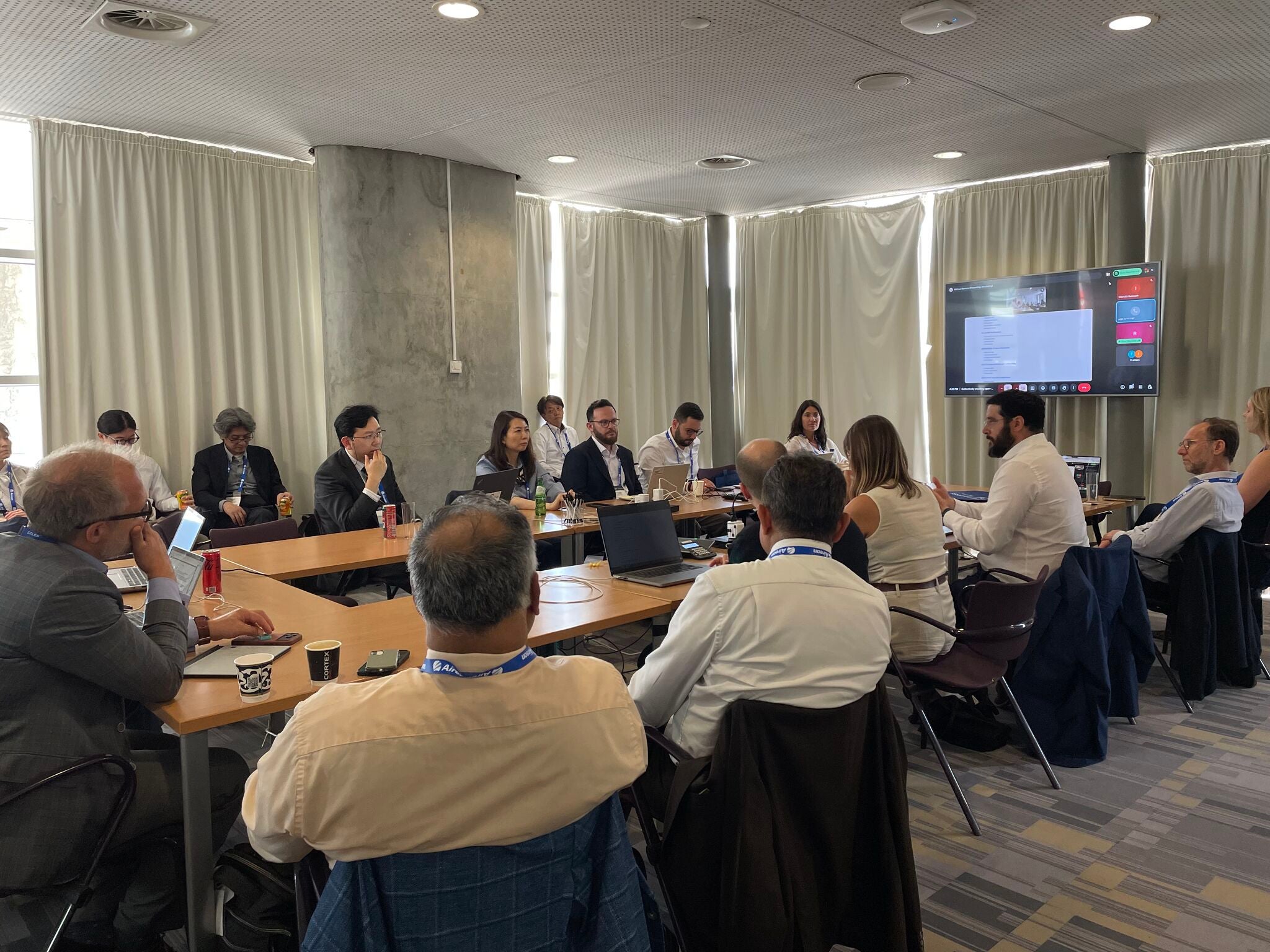
On May 27, during Airspace World 2026 in Lisbon, the InterUSS Platform convened both its Advisory Council and Open Industry Workshop, bringing together regulators, civil aviation authorities, U-space service providers, industry leaders and technical experts to discuss one of the most consequential questions facing drone integration today: how can trust, interoperability and scalability be achieved in increasingly complex multi-operator airspace environments?
The meetings provided a forum for open dialogue between authorities and industry while showcasing how open-source technologies can support the safe and efficient growth of UTM and U-space ecosystems worldwide. The sessions focused on governance, automated testing, interoperability, operational scalability and the future role of InterUSS in supporting global harmonization.
Advisory Council: where does trust still break down?
The Advisory Council session was structured around a central question: “Where does trust still break down?” Participants explored the challenges authorities face when overseeing increasingly digital, interconnected and rapidly evolving UTM environments. Discussions examined regulators’ concerns regarding multi-operator airspace, transparency, software change management, and maintaining confidence in systems that evolve continuously.
A recurring theme was that trust is not built solely through technology, but through transparent governance, documented processes and verifiable testing outcomes. Representatives from industry and government emphasized that regulators require confidence that interoperability continues to function as systems evolve and new capabilities are introduced.
In the US, the growth of UTM-enabled drone operations has been remarkable. By the end of April, approximately 468,000 flights had been supported through strategic deconfliction services, and that number had already surpassed 500,000 flights by mid-year. The vast majority of these operations were commercial package deliveries, although the system also supported a smaller number of other activities, including drone-first-responder missions and infrastructure inspections. Operations are expected to continue accelerating, with total flight volumes potentially approaching 2 million by the end of 2026. This rapid expansion highlights both the increasing adoption of drone services and the scalability of the underlying UTM infrastructure. Considering that UTM operations were effectively starting from zero in the summer of 2024, reaching more than half a million supported flights in less than two years is a significant milestone.
Demonstrating interoperability through Automated Testing
As part of the Linux Foundation, InterUSS leverages open and collaborative development to support interoperability across the UTM ecosystem.
InterUSS representatives highlighted the importance of community participation. Contributors help develop testing tools and interoperability solutions, while members actively shape open-source approaches that support the safe integration of advanced aircraft operations worldwide.
A significant portion of the workshop was dedicated to a live technical demonstration and guided discussion led by the InterUSS Technical Steering Committee. The session illustrated how the InterUSS Automated Testing Suite can evaluate ecosystem-level interoperability among U-space service providers and supporting infrastructure.
The demonstration showed how requirements, compliance matrices, test baselines, test scenarios and reporting mechanisms work together to verify that different systems can exchange operational information consistently and in accordance with agreed standards.
Workshop participants explored how interoperability testing supports real-world deployments and how common testing frameworks can reduce barriers for service providers entering new markets. Examples shared during the discussion highlighted how organizations implementing interoperable solutions can more efficiently adapt to deployments in different regions while maintaining compliance with local requirements.
Scaling for the next phase of drone operations
A major focus of the workshop was scalability. Industry experts discussed the rapid growth in operational volumes in the United States (the US UTM Implementation supported over 500,000 commercial flights during the first five months of 2026) and the need to ensure that interoperability solutions remain robust as demand increases. Conversations centered on performance optimization, usability improvements, test execution efficiency and future-proof system architectures.
The Technical Steering Committee outlined its current priorities, including:
- Improving usability and support for users
- Enhancing the Discovery and Synchronization Service (DSS) performance
- Developing testing patterns that reflect real-world operational scenarios
- Expanding the Automated Test Suite for U-space services
- Investigating next-generation DSS architectures
Particular attention was given to ongoing research into application-level consensus approaches for the DSS, aiming to support future scalability requirements while simplifying deployment and operational management. Early findings presented at the workshop demonstrated encouraging performance characteristics and sparked discussion on how open-source infrastructure can continue to evolve to meet future operational needs.
Looking ahead
The discussions in Lisbon reinforced the value of open collaboration between regulators, authorities, standards bodies and industry. Participants agreed that achieving scalable, interoperable airspace systems will require not only technical innovation, but also continued transparency, common testing approaches and sustained engagement across the ecosystem.
As the InterUSS Platform continues to expand its technical and governance activities, stakeholders were encouraged to remain engaged through in-person workshops, technical contributions and community participation opportunities.
The session concluded with an invitation to continue the conversation at the next major InterUSS gathering during Harmonized Skies 2026, taking place in Tokyo, Japan, on 5–6 October 2026.
Want to get involved?
Follow the InterUSS Platform on LinkedIn and contribute on GitHub

