

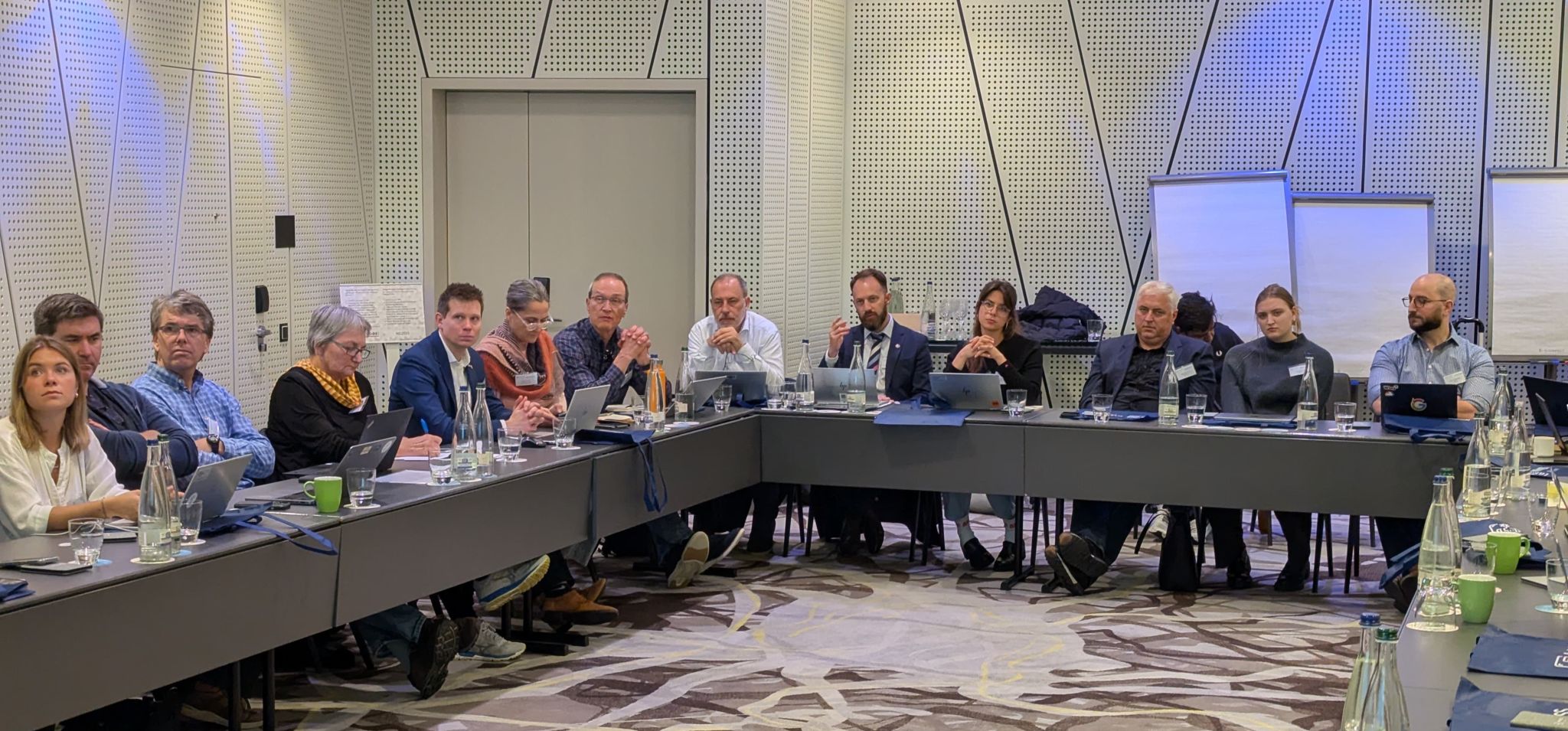
As drone operations continue to scale in volume and complexity worldwide, aviation authorities are increasingly turning to automation to ensure safe, efficient, and harmonized UTM oversight. At the latest InterUSS Platform Workshop in Zurich, held on 3 November in the context of GUTMA’s Harmonized Skies 2025, the Civil Aviation Safety Authority (CASA) of Australia shared its experience transitioning from manual to automated testing using the InterUSS Platform.
In this interview, CASA’s Remotely Piloted Aircraft Systems (RPAS) Specialist Sam Chapman explains the regulatory and operational drivers behind this transition and the concrete benefits automated testing brings to the Australian UTM ecosystem. The discussion also explores the role of Drone Safety Apps, interoperability testing, and open‑source technologies in enabling scalable oversight, continuous compliance, and international harmonization, offering insights relevant to civil aviation authorities and UTM stakeholders worldwide.

1 – CASA presented on the use of the InterUSS automated testing at the latest InterUSS Platform workshop in Zurich, on 3 November, organized in the context of GUTMA’s Harmonized Skies 2025. We heard how the rapid growth of drone operations in Australia is pushing CASA to transition from manual to automated testing. What informed CASA’s transition to automated testing? Could you provide some information on the practical advantages this will bring to the Australian UTM ecosystem?
Sam Chapman: CASA’s transition from manual to automated testing has been informed by both international UTM standards and the practical realities of a growing drone services ecosystem in Australia. In particular, ASTM F3548-21 assumes a federated UTM environment in which multiple UAS Service Suppliers (USSs) operate concurrently in overlapping airspace and are subject to ongoing regulatory oversight. The standard also expects that testing is conducted as closely as possible to real-world production conditions, with outcomes assessed against whether core operational and safety objectives are met.
ASTM F3548-21 also explicitly identifies automated testing, including USS interoperability testing, as essential to scaling regulatory oversight. Automated testing significantly accelerates the USS onboarding test process, the time required to validate updated USS software, and reduces the risk of human error. This becomes increasingly critical in a multi-provider ecosystem, where fixed and infrequent manual testing cycles can delay corrective updates, slowing innovation, and constraining safe market growth. Automated test methods also support the automatic generation of audit-ready reports, improving transparency and traceability, and meeting standardised recordkeeping requirements.
Beyond initial USS onboarding and software update validation, automated testing enables continuous compliance monitoring. Via automated pre-set scenarios and dynamic test data feeds, even parallel with live operations, CASA can support ongoing operational audits to verify that USSs continue to meet defined performance and safety requirements.
In the Australian context, this transition is particularly important due to the complexity and scale of Australia’s Airspace Awareness Service, which digitises CASR Part 101 operating requirements for recreational hobbyist, commercial-excluded, under 250 gram, and remotely piloted aircraft operator’s certificate (ReOC) holding operators. These regulatory requirements are nuanced and require substantial subject-matter expertise to interpret and verify when assessing third-party implementations of the service. CASA staff with this expertise are already supporting a fast-growing recreational user base and an expanding commercial drone sector. So automating testing reduces reliance on scarce specialists, allowing CASA personnel to focus on higher-value regulatory activities.
Overall, automated testing strengthens the Australian UTM ecosystem by improving scalability, enabling faster innovation cycles and supporting continuous compliance at a time where drone operations employing these services continue to grow in volume, complexity, and societal importance.
2 – What services do Drone Safety Apps provide? How does that relate to InterUSS Platform automated testing?
Sam Chapman: Drone Safety Apps provide an Airspace Awareness Service, which is equivalent to the Aeronautical information service defined in the ICAO document UTM – A Common Framework with Core Principles for Global Harmonization. This service enhances the situational awareness of model aircraft and remotely piloted aircraft (RPA) operators by delivering near real-time, location-specific aeronautical information relevant to their intended operation and aligned with CASA’s regulatory requirements. The service presents information on airspace boundaries, aerodrome no-fly zones, permanent and temporary Special Use Airspace (including danger, restricted, prohibited, and military operating areas), as well as other critical constraints.
In addition to airspace information, the service may provide contextual regulatory guidance based on the operator’s flight parameters, helping users understand and interpret applicable legal obligations, restrictions, and whether additional permissions or approvals may be required.
To verify correct implementation of this service, DSAs can choose to use the InterUSS automated test suite which has been integrated into CASA’s RPAS Platform. The current test configuration for the Airspace Awareness service includes 102 automated test scenarios spanning four defined user categories: Recreational (hobbyist), Commercial-excluded, Micro RPA operators, and remotely piloted aircraft operator’s certificate (ReOC) holders. These scenarios simulate real-world operational contexts to confirm that users receive accurate, category-appropriate airspace information and regulatory guidance.
Drone Safety Apps may also provide an Automated Airspace Authorization Service to validated ReOC holders. This service enables near real-time automated approvals for operations conducted under an existing CASA-issued authorization, within designated airspace and subject to predefined operational criteria. Where eligibility conditions are met, the system can grant an authorization without requiring manual CASA intervention.
The InterUSS automated test suite is also used to validate correct system behaviour for this service. The current test configuration includes 8 automated test scenarios, designed to confirm that authorizations are granted when operational criteria are satisfied and withheld when they are not, ensuring regulatory compliance and consistent decision-making. This service also relies on a correct implementation of the Airspace Awareness Service to function, so the test scenarios for that service related to ReOC user category are also applied.
The current automated test scenarios developed for both the Airspace Awareness Service and the Automated Airspace Authorization Service are designed to be forward-compatible with UAS Service Suppliers (USSs) that will connect to Airservices Australia’s Flight Information Management System (FIMS) as part of the UTM ecosystem launching in 2026.
3 – We have seen in a previous interview with the FAA that the InterUSS automated testing was employed for the UTM Operational Evaluation in several US states, such as Texas, Utah, Arkansas, and New York, while the Swiss Federal Office of Civil Aviation is also conducting operations by using automated testing. Does CASA regularly engage with these CAAs to exchange experiences and best practices? Are there other CAAs or international partners you cooperate with?
Sam Chapman: The annual GUTMA conference provides an excellent forum to engage with NAAs on UTM-related activity and best-practice globally. CASA and like-minded NAAs regularly touch base more broadly on a range of RPAS and emerging technology policy development and implementation activity.
4 – What learnings does CASA have working with open-source technologies? What should other CAAs consider when engaging with platforms like InterUSS?
Sam Chapman: Open-source ecosystems enable CASA to benefit from advances pioneered by overseas regulators and industry, including features such as dynamic data testing (e.g., emergency incident feeds and airspace constraint changes issued via NOTAM), without needing to develop these capabilities independently.
One key learning is that the speed of innovation is often higher in open-source environments, where both industry participants and regulatory authorities contribute improvements. This distributed development reduces the impact of capacity constraints, allowing regulators to adopt mature solutions more quickly than would be possible normally.
Additionally, CASA has found that open-source platforms like InterUSS meaningfully support global harmonization of UTM oversight and service assurance. Because these platforms are developed collaboratively across multiple jurisdictions, they tend to be standards-aligned and modular, making it easier for software providers to adapt (or port) from one national regulatory environment to another.
5 – Could you outline what’s on the horizon? When should the transition to automated testing be complete, and what is the roadmap for future services and platforms?
Sam Chapman: CASA is committed to supporting the Australian Government’s UTM Action Plan, which sets out a phased roadmap for the rollout of Australia’s national UTM ecosystem. This plan outlines the progressive introduction of digital airspace services, UAS Service Suppliers (USSs), and supporting regulatory frameworks to safely enable more complex and higher-density drone operations.
A key near-term milestone is CASA’s transition from predominantly manual testing to automated conformance testing. This transition is being formalised through Version 5 of the Airspace Awareness and Automated Airspace Authorization service rules, which will mandate automated testing as part of service onboarding, update approval, and ongoing compliance oversight. CASA expects automated testing to become the primary mechanism for service assurance as UTM services scale and USSs connected to Airservices Australia’s (our ANSP) Flight Information Management System (FIMS) come online from mid 2026.
In parallel, CASA is developing a UTM services assessment and approval framework to support the introduction of new services, including those that would support Beyond Visual Line of Sight (BVLOS). This framework will outline how CASA evaluates the safety credit, performance requirements, and regulatory obligations associated with new UTM-enabled services.
Note: In this context, a federated UTM system means a distributed model where multiple independent UAS Service Suppliers provide services in shared airspace, while adhering to common standards that allow them to interoperate safely under regulatory oversight.
More information on CASA’s RPAS Platform can be found at https://www.casa.gov.au/drones/industry-initiatives/digital-platform

