

On the 23rd of March, the InterUSS Platform successfully concluded its workshop and Advisory Council sessions in Düsseldorf, with in‑depth discussions on real‑world UTM and U‑Space implementation.
The event provided a valuable forum for participants to exchange experiences, highlight ongoing deployments, and explore how open-source tools, such as the Automated Testing Suite, and robust governance models can accelerate the development of safe and interoperable UTM/U‑Space ecosystems worldwide.
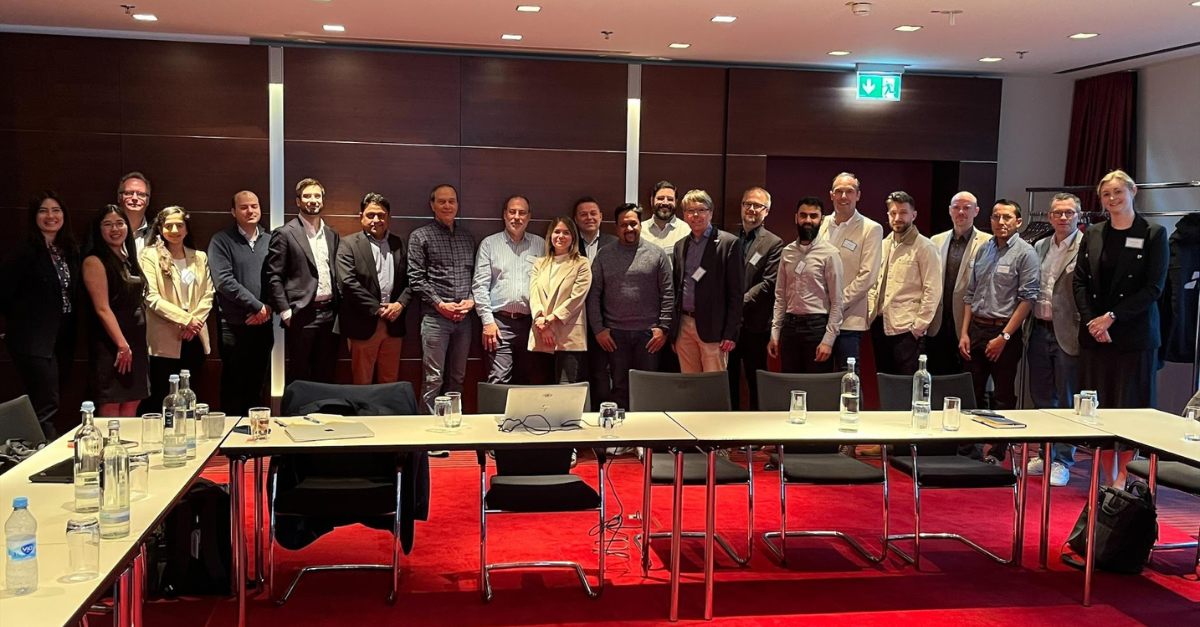
Advisory Council: regulatory perspectives on UTM and U-Space implementation
The first part of the workshop focused on the InterUSS Advisory Council, which convened regulators, authorities and Standards Development Organizations (SDOs) to share national implementation experiences.
The meeting included representatives from Civil Aviation Authorities in Australia, Canada, Estonia, Ireland, the Netherlands, Switzerland, the United Kingdom, and the USA, as well as representatives from ASTM, EUROCAE and EUROCONTROL.
Across the session, participants exchanged perspectives on interoperability needs, oversight models, software assurance, and discussed harmonization challenges to avoid fragmentation.
The presentations illustrated how automated testing is used during onboarding to an interoperable environment and as a foundation for nationwide scalability. The discussion emphasized the importance of early testing assumptions and building confidence through independent, automated validation.
The Advisory Council once again demonstrated its role as a forum for identifying regulatory gaps, aligning priorities, and providing directional input to InterUSS Platform activities.
Open Industry Workshop: lessons from deployment and the value of automation
The second part of the workshop brought together industry and public organizations representatives for an open discussion focused on implementation and collaboration. Participants shared concrete lessons learned and real‑world experiences that continue to inform and refine the InterUSS Platform roadmap.
Attendees also highlighted the costs and risks associated with fragmentation: without harmonization, manual processes and divergent approaches were seen as creating unsustainable time and cost burdens. Automated Testing and other open-source tools were identified as critical enablers for faster, more economical rollouts across regions.
Another major theme was the importance of a shared baseline: governance frameworks and open-source resources were seen as essential in providing common assumptions and reusable testing foundations. While setting up these structures requires an initial investment, participants noted their scalability, drawing parallels to the growth of UTM implementation in the United States.
The discussions further emphasised that constant iteration is no longer optional. During the U-space Field Test V1, FOCA conducted around 90 test sessions over two months, representing approximately 800 minutes of active testing. These sessions focused primarily on Flight Authorisation (about 21 minutes per session across 81 test scenarios) and Remote Identification (about 15 minutes per session across 39 test scenarios), allowing participants to repeatedly validate services under real operational conditions. Unlike traditional air traffic management models, where software is often frozen once approved, the field test demonstrated how U‑space deployments rely on continuous refinement, with rapid bug fixes and frequent updates integrated directly into operations. Participants consistently identified this ability to iterate quickly as a decisive advantage and a foundational requirement for the scalability, resilience and long‑term viability of future U‑space and UTM systems.
Finally, there was broad agreement that implementation itself delivers critical knowledge: many operational hurdles and manual processes only become visible once deployment begins.
Enabled by the independent, open-source Linux Foundation project, the Automated Testing Suite, when combined with continuous ecosystem input, represents an essential tool for supporting a digital, iterative approach.
Looking Ahead
The Düsseldorf workshop reaffirmed that demand for advanced operations, especially BVLOS (Beyond Visual Line of Sight), is already present, both within and outside the U‑space ecosystem. Across regulators and industry alike, there was a shared understanding that harmonization, trust in automated tools, and continued collaboration are essential to meeting this demand efficiently and safely.
InterUSS extends its sincere thanks to all authorities, organizations, and participants who contributed to the discussions and shared their experience. The outcomes of this workshop will continue to inform the development of open-source tools that support interoperable, scalable UTM and U‑space implementation worldwide.
For any inquiry on the workshop, contact outreach@interussplatform.org

